This winter, BUILD visited with architect, urban planner, and professor Cornelia Redeker — head of the architecture school at Umeå University — to discuss regenerative design across two very different landscapes: Cairo and the subarctic. Redeker shares her vision for buildings that actively produce ecological benefit rather than merely reducing harm, and why climate urgency makes circularity an architectural imperative.
Tell me about your path into architecture and what brought you to heading the department at Umeå.
In parallel to my PhD at TU Delft on urban flood management and teaching at TU Munich’s Chair for Urban Design and Regional Planning, I ran my own consultancy, Cities on Rivers, for many years. I am originally from Germany and partly grew up outside of San Francisco, but I have a Swedish mother and was always interested to live in Sweden, but I was also eager to experience a different kind of reality outside of Europe and the Western world. That opportunity came in Cairo. I was part of a team to set up an architecture program from scratch at the German University in Cairo. The people, the scale of the city, of course the Nile, and the whole richness of that context are truly amazing. I ended up staying for eight years and although at a certain point it was time to return to Europe, I keep on going back.

When a position opened at Umeå School of Architecture in 2021, I applied. I arrived in February during COVID, at minus 20 degrees, to a city that felt particularly still. But it struck me as a good place, especially after the intensity of Cairo. I work very context-specifically, and the vastness of the landscape and subarctic climate — having worked in temperate and arid zones — felt like an intriguing new frontier. I was later promoted to professor, and when the opening for head of department arose, the school was in an interim situation with management coming from outside the discipline. Given my experience building and running the Cairo program I felt I could contribute.
I arrived in February during COVID, at minus 20 degrees, to a city that felt particularly still. But it struck me as a good place, especially after the intensity of Cairo.
Explain your research in the Netherlands.
Coming from Cologne, a city highly impacted by the Rhine floods in the mid-nineties, my PhD dealt with urban flood integration at different scales along the Rhine from Basel to Rotterdam based on the Dutch Room for the River approach and as part of the FloodResilient City project. It was the time the European Flood Directive was being implemented and I was interested to see how landscape solutions synergize flood mitigation and adaptation strategies with new qualities for the built environment and other co-benefits for this highly engineered river.
How did your time and research in Egypt shape your career and teaching?
Egypt is vast, with 95% of the country being desert. The population grows by roughly one million inhabitants every ten months, and a large portion of urban development in the past has been informal. Egypt is probably one of the most dynamic urban development corridors globally and the challenges are complex— between primarily market-steered new desert developments and the extremely dense historical and informal areas there is an enormous pressure regarding water, energy and spatial justice. A response to the given challenges across these highly diverse built environments that could improve microclimates, produce food, treat water while enabling aesthetic and social qualities are landscape-based: green facades, rooftop farming, planting trees in the spaces between buildings, treatment wetlands, and at a larger scale coupled to the New Urban Communities in the desert, concepts such as desert forestation and wadi urbanism. I launched the design studio series Designing Cycles to explore these approaches quite early in my time there, and we ultimately published the book, Landscaping Egypt: From the Aesthetic to the Productive, which combined the history of landscape development in Egypt with design scenarios developed together with students, researchers and practitioners in the field. The book also includes a plant atlas of productive species. I was living on Dahab Island in the middle of Cairo — which is car-free and largely agricultural — and founded the Nile Islands Initiative to exemplarily highlight the island as a green lung and threatened ecosystem for a city with one of the lowest green-area ratios per inhabitant — to offer an alternative logic to the market-driven and informal development pressures it is currently exposed to.

Was ‘Designing Cycles‘ the conceptual DNA for your research here at Umeå?
Yes, I brought that thinking with me. The core idea is that the built environment has an enormous capacity to contribute to a regenerative logic: not just reducing harm, but actively producing ecological benefit. The focus is on transforming the built environment to increase self-sufficiency and to reduce the pressure on landscapes at large. That logic is especially relevant here in northern Sweden, which is Samí land. As reindeer herders, the Samí’s indigenous practices are tragically impacted by climate change and current industrial and infrastructural development in one of the last regions with old-growth forest at meaningful scale. Both are in dire need of being protected. Things are moving too fast.
At the same time within the Swedish planning system, municipalities carry enormous responsibility and are reliant on models of growth. In our research group we are interested in decentralized approaches on the building and neighborhood-scale that make sense whether the large industrial transformations unfold as planned or not. As a no-regret strategy the primary goal is to increase self-sufficiency while reducing overall resource demand. That creates a form of resilience to global market fluctuations, supply chain disruptions and of course climate change that potentially have such an outsized impact on small northern communities.
You’ve written about buildings as producers rather than consumers. What does that look like in practice?
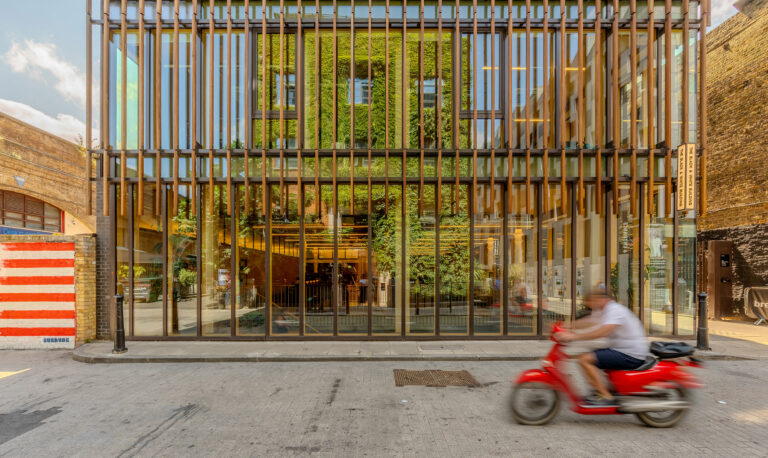
When I arrived in Umeå, I wanted to continue with nature-based and passive architectural solutions that offer untapped potential. We started the research group Designing Cycles at 64° and the Water-Energy-Food Nexus. I came across Bengt Warne’s Naturhus concept from the 1970s and diverse explorations thereof by Tailormade Architects — essentially integrating buildings into greenhouse extensions, which creates energetic benefits and an intermediate climate zone. In the north, this has particular value: it allows us to extend very short growing seasons and to integrate circular systems for water, waste, and food production at the building scale. While this is not a new concept, it has rarely been upscaled to collective housing. Given the housing pressures we are facing also here, I felt that upscaling was important. We did some preliminary evaluations for Umeå — looking for example at the million-program housing blocks with their flat roofs and south-facing facades — to estimate the city’s cumulative capacity if retrofitted at scale.

We then sized down considerably to run testbeds in more rural contexts where challenges and typologies are quite different. One is on Holmön, an island community constrained by limited water availability during summer, which has frozen development and prevented the provision of basic social services like schools, etc. The idea is to demonstrate that a reduced water footprint through rainwater harvesting and treated greywater reuse can potentially enable new water licenses. We built a tiny house there last year as part of a UMA summer school to provide a research infrastructure for the Interreg Nordic Peripheries and Arctic project Bauhaus Goes North — a collaboration with Applied Physics and Electronics at Umeå University and Aquatic Biology at Aarhus University and most importantly the islanders, also in exchange with Cork Islands. This summer we are completing the building with a decentralized water system including a constructed wetland.

We are part of another project closer to the city, where an active community is transforming an old barn into a resilience hub. Rather than the standard preparedness infrastructure — diesel generators and stockpiles — they want to explore what a preparedness culture rooted in everyday life can look like. We are planning a greenhouse extension, a root cellar, and a constructed wetland. Both sites are living labs: research infrastructure that works with and for the community, which is always an interesting dynamic to organize.
Tell me about urban housing in the subarctic and how it intersects with ecological cycles.
The ecological cycles here are historically quite specific. Short summers with extensive light followed by long dark winters and now due to climate change severe temperature fluctuations within a short time period. We are not only in need of handling rainwater but vast amounts of snow and meltwater. Climate change is hitting the north hard — including unexpected dry periods in summer. Requirements for urban water management create new tasks for integrating those cycles within the built environment in a meaningful way.
The Naturhus model is particularly relevant to this climate zone in terms of both energy savings and the creation of transitional space. It connects to the traditional Swedish typology of the altan, the glassed-in veranda. There are precedents: a glazed courtyard connecting multi-story linear housing built here in Umeå in the 1990s, and a million-program facade transformation in Gothenburg from the same era and more recently “The Gardens” project in Örebro by Marge Architects. But these are not used to produce food or recycle water and waste. The model never mainstreamed, mainly because of initial costs, but also maintenance responsibilities and potentially because the urgency was not what it is today. I think it is worth revisiting these models. There are efforts to do so across Europe, but significant economic challenges remain.
When revisiting models of the 1970s like the Naturhus, one realizes how little these kind of projects have actually progressed. The architectural culture of the 1990s and 2000s produced work of enormous spatial and aesthetic quality but largely disconnected from environmental considerations. And alternative models, of which there are many, never hit a relevant scale — they stayed at the level of single-family houses and niche projects, which are much easier to organize but lack transformative capacity when looking at the socio-ecological challenges at hand. A huge barrier is still the misalignment that benefits often accrue to different actors than those bearing the initial costs.
We are not only mitigating anymore; that won’t be sufficient. We must think in regenerative terms in parallel with the immediate work of adaptation.
What does it mean to be climate positive in architecture?
Climate positive goes beyond robustness and resilience, though both are necessary. It means thinking regeneratively — producing a positive ecological footprint rather than simply reducing a negative one. We have to do more with less — together. That is a design task. Framing matters. It is less about crisis and more about a genuinely positive outlook on the transformation ahead. We are not only mitigating anymore; that won’t be sufficient. We must think in regenerative terms in parallel with the immediate work of adaptation.
Are there larger-scale projects you point to as examples of working with natural systems rather than against them?
On a larger scale there are many projects I find inspiring regarding how they work with natural systems, but also regarding their transformative capacity, I will name three. The Netherlands offers many examples, particularly around water, one being the Room for the River project in Nijmegen. To mitigate the flood impact created by the bottleneck in the Waal River at the height of the city, a bypass was created coupled to a compact urban expansion strategy combining flood management and nature development with urban growth in a beautiful way. Another project which has all my admiration is the wadi cultivation project Marsadev in Marsa Matrouh, Egypt, where the Desert Research Center, among others, together with the local Bedouin community, have created a cascading landscape with micro-catchments that integrate old Roman cisterns to slow down and harvest the rare but often heavy rains. Instead of running off into the saline Mediterranean sea, the rainwater enables fig and olive cultivation and provides a livelihood. Project number three is the Giess den Kiez project by Citylab Berlin where the digital tree register was made public in an App to enable citizens to water the tree according to their actual needs. This has saved thousands of trees during the extended periods of drought during the summers and is an open source software which has been adapted by other cities. In all of these projects, there is an enormous capacity for upscaling.
How is circular thinking showing up in the studio curriculum at Umeå?
We are currently revising our curriculum. Circular thinking is being integrated from year one — starting with basic concepts like adaptive-reuse of the existing building stock, life-cycle thinking, moving through resilience and robustness, toward regenerative strategies. Different colleagues at UMA are working with adaptive reuse and reused building materials in the design studios and in the design-build formats. We also have a computational and digital materials research group working on bio-based materials that include waste products from the forest industry. Our teaching collaboration with the building engineers shows how challenging it is to work with reused and other alternative materials as they are not necessarily found in the libraries of the simulation software. That reflects the current challenges around certification also in practice.
What is essential is being part of a broader ecosystem. Umeå is quite interesting here: there is a reused materials hub connected to a city-wide network where the building sector collaborates on procurement, certification, and best practices. How to create detailed design solutions for reused materials — e.g. how to work with single-layer glass elements where you need triple-glazing is something where UMAs building technology team can contribute. It is about creating a systematized design knowledge and I think that’s where academia can make a distinctive contribution.
What is the single biggest lever for accelerating the circular economy beyond the university?
The EU is doing a great deal including the New European Bauhaus through, among others, the Horizon program and the development of financial instruments aimed at upscaling. And nationally Shift Sweden and other mission driven programs are certainly facilitating change. These are significant systemic efforts. We are however still at risk of projectification and need to become better at evaluating and upscaling successful models to enable policy change and financial incentive. We are at a paradigm shift, and cross-sectoral collaboration is happening — but it remains a challenge for all involved.
What will normalize reuse and circularity with the general public?
Up here, there is already a strong self-build culture. As soon as the snow melts, people are renovating and building. There is a culture of repair built into the seasonal rhythm. And as soon as there is a clear economic logic to reusing materials — and there often is, since much reused material is simply unused construction surplus — people embrace it pragmatically. For the building industry more broadly, it is those networked processes, like what Umeå is building, that will shift the norm. We already have good examples here: a student housing complex retrofitted with a substantial share of reused interior materials, and the university library currently being refurbished in the same way. More examples build confidence.
As long as we have vacancies, demolition should simply not be an option. It should be a design challenge.
Where does the architect’s responsibility begin and end in the circular economy?
The beauty of architecture is that it combines artistic and scientific inquiry — a distinction I find somewhat unproductive when pushed too hard, though it is a genuine debate in Sweden. I think architects have a responsibility to demonstrate the spatial potential of reused materials and circular approaches by design that inspires people to live in a more resourceful way, not just for technical feasibility. To do so, we need to start at phase 0 and need to create much better interfaces with all parties involved in the building process.
But reuse is not only about reusing building elements — it is fundamentally about the existing building stock. Working with vacancy, with what is already there. Regional specificity matters enormously: the old timber constructions scattered across the Swedish countryside represent a material quality that modern timber can no longer match. Creating enabling policies and financial incentives for reuse and using digital platforms to map and make those materials accessible and asking what architecture we can produce from what already exists — that is a rich design challenge. We have a long Swedish tradition of moving entire houses — a practice that embodies a very different relationship to buildings and permanence. As long as we have vacancies demolition should simply not be an option. It should be a design challenge.
What makes the architecture department at Umeå University unique?
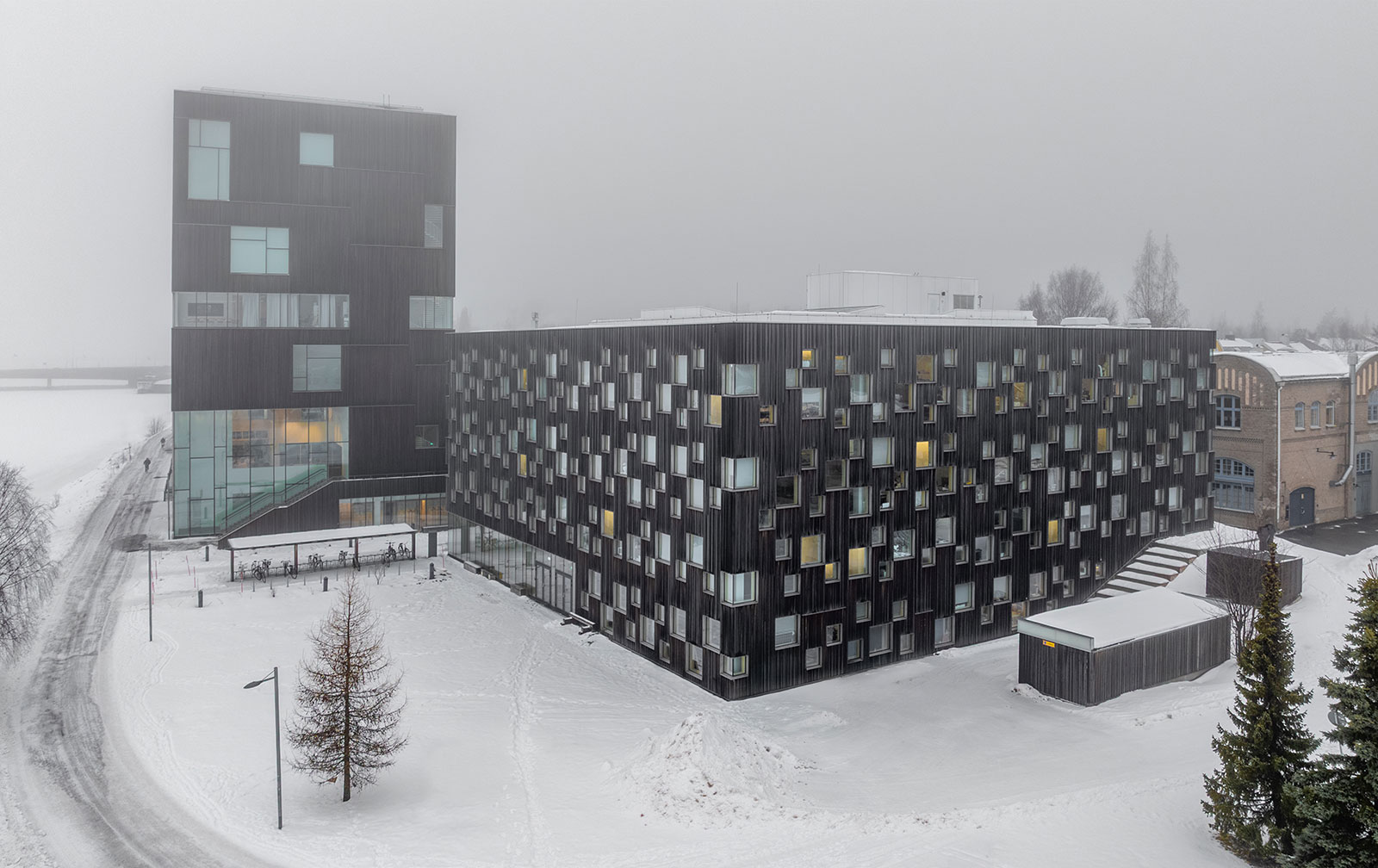
UMA is the youngest and northernmost architecture school in the country and an emergent research environment that is shaped by its geographic location in the periphery of Europe and of Sweden, while our faculty and researchers come from all over the world. The openness and simultaneity of the building layout, and being part of Umeå University’s Arts Campus designed by Henning Larsen and White Architects directly located on the river, creates a very special learning environment that is really inspiring for all of us. UMA has a strong artistic legacy but is also diversifying as the school is growing. We are the only program in Sweden that is completely taught in English. At the same time, we are very engaged in the local and regional ecosystem. The school operates between local and global dynamics in a way I find genuinely productive — and increasingly necessary. Our master studios reflect that directly, focusing on the three major urgencies of our time: territorial design, migration, and housing.
Three books every architect should have on their shelf?
I would still say A Pattern Language by Christopher Alexander — his work is all-encompassing and remains relevant even within contemporary design logics.
Byggekologi by Maria Bloch and Varis Bokalders, which is a great compendium, and I believe there’s an English translation.
The Art of Building Cities by Camillo Sitte, as a reminder not to lose the knowledge of city-building and the social role of urban morphology. With all our current focus on circularity and climate urgency, we cannot afford to lose the spatial intelligence that Camillo Sitte, Jane Jacobs and Jan Gehl represent. I see it with students here — surrounded by such vast, open landscapes, buildings begin to float freely, and the logic of urban morphology and neighborhood scale starts to slip away. That knowledge needs to be actively maintained.
I would also add the A+T series and Detail Magazine. They find ways to make complex material genuinely accessible to students and practitioners alike, and they should be on every architect’s regular reading list.

Cornelia Redeker is an architect and urban planner. Her work revolves around climate-adaptation with a specific focus on landscape-based design strategies. Since fall 2023, she holds a professorship in architecture at Umeå School of Architecture at Umeå University (UMA) and is head of the school. Before joining UMA in 2021, she was associate professor for architecture and urban design at the German University in Cairo from 2012. She holds a PhD on urban flood integration along the Rhine from TU Delft. In parallel to developing her PhD research, she was teaching urban design and regional planning at TU Munich. With her office Cities on Rivers / Cities on Sand, Cornelia has worked as a consultant internationally. At UMA she has initiated the research and teaching lab Designing Cycles at 64° exploring how buildings and their inhabitants can turn from being consumers to becoming producers within the built environment of the sub-arctic aiming to accumulatively have a systemic impact. Cornelia is part of the expert panels for the EU Commission’s New European Bauhaus facility and Shift Sweden Impact Innovation.