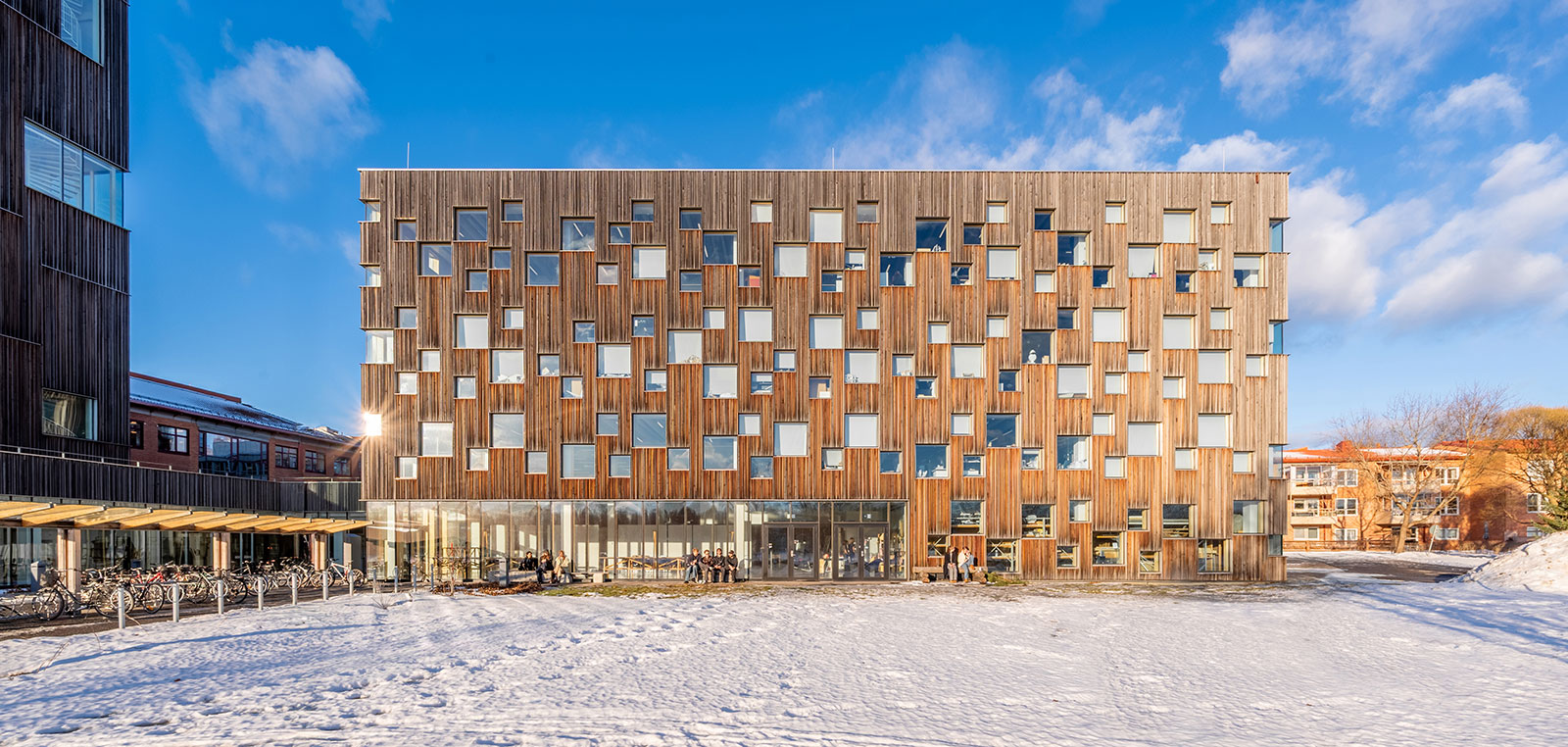
This winter, BUILD visited Sara Thor at the Umeå School of Architecture, where the architect, lecturer, and PhD candidate is investigating what it would take to scale regenerative design from a single greenhouse dwelling to an entire climate zone — and why the biggest challenge isn’t the building, it’s the process.
Tell me a little about your background—where you studied, how you got to Umeå.
I’m from Gothenburg, on the west coast of Sweden, where I also studied—apart from an exchange year in Paris at La Villette and in the UK, where I completed the Part 3 Professional Practice Qualification. My path wasn’t entirely linear. After my third year I took time out to work, living and practicing in Brighton, England for several years before finishing my master’s degree. I returned to the UK after my diploma and worked there in smaller practices for about five years before I moved to Umeå.
What prompted the move?
I was a little disillusioned with practice, especially working in London where development is so obviously driven by monetary interests. Older buildings get converted quickly rather than carefully, with little consideration for context. Planning departments work hard, but there’s enormous pressure for speed. I came to Umeå for what was initially a one-year substitute lecturing position, and I felt almost immediately that it allowed me to engage with the core questions of architecture in a way that had been difficult in practice. Since then, I’ve also come to believe that there are many roles for architects beyond the traditional practice-based designer—where architects can step up and participate in development in very different ways.
How do you explain regenerative design in common terms?
I think it goes back to understanding how everything is interconnected—that we as humans are part of the ecosystem, not separate from it. Regeneration, as I think about it, is not just reaching net zero, but achieving net plus: giving something back. And I think the term has real potential beyond design—it could be applied to many aspects of life. There’s also an important distinction from how “regeneration” gets used in property development, where it often just means redeveloping an industrial area and the gentrification processes that follow. That’s something else entirely.
What’s the difference between regenerative design and sustainability?
Sustainability has become something of a label—and as a concept, it implies keeping things lasting over a long time, which is somewhat static. Regeneration, by contrast, has movement built into it. It’s about rebirth and cycles, including death, which is not an endpoint but part of something ongoing. I also think it has a potential for reciprocity that sustainability, at least conceptually, doesn’t quite carry. Ecosystems, communities, and solutions all have this capacity to give back. Sustainability doesn’t necessarily invite that in the same way.
Regeneration has movement built into it. It’s about rebirth and cycles, including death, which is not an endpoint but part of something ongoing.
Explain the nexus of water, energy, and food that’s central to your work on housing in the sub-Arctic.
This comes out of a research group I started with my colleague Cornelia Redeker, which grew from a project exploring the concept of the Naturhus. The Naturhus is not a new idea—it was developed in the 1970s by the Swedish architect Bengt Warne and could be described as a single household unit built inside a greenhouse, with integrated circular systems for water, waste, and food production. Waste becomes compost and feeds back into the loop. It is not a high-tech system but rather built on an understanding of how the different cycles connect. That was our starting point. On the energy side, it’s less about producing energy and more about conservation—passive architectural strategies that respond to specific climate and context. That’s roughly the water-energy-food nexus. My current PhD thesis, now about a year and a half in, has evolved from those foundations. I initially planned three case studies at different scales, but a few months ago we received funding to actually build physical pilot environments in a rural village outside Umeå called Stöcke, where we had done a pre-study. That has now become the primary focus—a 40-month project in cross-sectoral collaboration with two municipalities, the community organization, and a network of specialists in areas like water management and food conservation techniques.

How do you and the university fit into that collaboration?
The community knows the landscape, they own the property, and they’re connected to the village’s social hub. What they don’t have is design and technical expertise. Through our research group Designing Cycles at 64°, Cornelia and I bring that—we are also facilitators and enablers of the process. It’s worth noting that this is a genuinely strong community. They managed to build their social hub by pulling together funding, and that history of collective action is part of why the project is viable. They found us, actually—someone in the organization had heard about our earlier research and reached out, because their interests around local food production and collective approaches overlapped with ours.

How did you approach writing the funding application, and what do you think gave it the best chance of success?
When you write a funding application, you have to be in the mindset that it’s already happening—and then you submit and have to stop thinking about it because the chances of receiving funding are slim. Then suddenly you get an email notifying you of the result. What made it feel especially meaningful was that I had the privilege of writing the application together with the community organization’s representative. My PhD work on scaling these solutions fit naturally into the larger project goals, and I built in activities that allow me to look speculatively at how the models we’re developing in this rural context might transfer to an urban setting. That scope also strengthened the application, because it showed the work wasn’t only relevant to one small village but potentially to a whole climate zone.
What does a community need to offer in order to gain this kind of resilience?
In the pre-study, we developed different scenarios—some reaching very high levels of self-sufficiency. The link to preparedness is obvious, and that’s very much in vogue right now. But the important distinction in our project is that we’re not thinking about preparedness as something reactive—a storage room you unlock in a crisis. The hypothesis from the start was that if you build resilience systems into everyday life, they have value on a daily basis, not just in emergencies. Growing food together, repairing a bicycle in a shared workshop—these things also build social resilience. They reinforce interconnectedness: that we are part of the ecosystem, that we don’t always need to buy new things, that shared knowledge within a community has real value. Resilience, at the local level, has a very strong social dimension.

How do these regenerative communities you’re building differ from traditional agricultural communities from a century ago, which were self-reliant out of necessity?
The goal isn’t full self-sufficiency—it’s more about reconnecting to knowledge that already exists in these communities, especially in rural places where people have lived for generations and carry a different connection to the land and its history. What we’re trying to build is the understanding that you don’t have to leave your job and become a full-time farmer. For younger people especially, it’s about understanding the systems we depend on—and at the same time building in contingency in case our centralized systems need buffering. As part of the pilot environment we are going to build a decentralized, nature-based water system which is visible rather than hidden away. That’s where architecture comes in: you can design infrastructure as part of a social environment, not just as a utility.
Tell me more about Bengt Warne as an inspiration.
He was a Swedish architect active from the 1960s to 1990s. He was visionary but in quite a humble way, promoting ideas about living in symbiosis with nature as part of a human-ecologist approach. I hadn’t encountered him until I came to Umeå—he was never really part of the curriculum when I studied. What strikes me is how he combined different systems with what must have been a vast knowledge of their potentials. He built his own house outside Stockholm, which was one of the first examples—and because it was his own, he had the freedom to experiment. That house became a model that has since been replicated, and there are contemporary versions across Sweden. It’s interesting because the Naturhus is a model in the truest sense: it’s not about how something looks, it’s about how it works, and it can be adjusted to different contexts. That kind of open-source generosity—sharing a model for how things can be done—is rare. But the Naturhus has only ever existed at the single-household scale. One of the central questions that has driven both our earlier research group and my PhD is: what prevents us from scaling these solutions? We have the building technology. We just don’t have the tools or processes to make it happen at other scales.

What are the current challenges in Sweden when it comes to creating housing of this kind?
There are several layers. The economic situation means developers need to make the numbers work, which makes it harder to take risks or do things differently. We’re also structured in a way that’s very efficient but not set up for variation: Sweden has very large building companies and very large architecture firms. The system is optimized for doing things at scale in the conventional way. And then there are the building regulations, which are currently changing in ways that are a reason for concern—they include a higher degree of uncertainty and a risk of creating housing with lower standards for daylight, for example. These changes come into full force during the summer of 2026, and even the authorities responsible for implementing them aren’t fully certain what the outcomes will be. It feels like a marketization of quality—making it easier for developers to build, without evidence that the market will regulate quality upward on its own. And yet doing things differently is exactly what the situation calls for—which brings me back to the question of knowledge.
I think the distance between research and practice is still quite wide—not just in Sweden, but in many countries. The tradition has been that you study architecture, you graduate, you go into practice, and you never look back. Some offices now have research departments, but it’s not very common. I think strengthening the connection between practice and research could help precisely in situations where we need to do things differently—if offices don’t have internal research capacity, that connection back to academia becomes even more valuable.
It feels like a marketization of quality—making it easier for developers to build, without evidence that the market will regulate quality upward on its own.
How is architectural education keeping pace with all of this?
Architects’ training prepares you to think across perspectives, not just whether the structure holds. But that generalist sensibility is under pressure as the curriculum has to expand to cover more: life cycle analysis, sustainability, community engagement, and a multitude of digital tools. At some point you have to ask: what do you take away from the academic experience to include these items? We’re still working that out.
It’s fascinating to think that buildings could become producers rather than consumers. What needs to change for that shift to happen?
Regulations need to change, and that’s not trivial. In this climate, one of architecture’s fundamental tasks is to keep water out—so the idea of bringing water back into the building, making it part of an active system, meets real resistance from planners and building departments. We need examples that demonstrate it can be done. Beyond regulation, there’s the whole chain of knowledge and decision-making, from the people physically building on site, to contractors, developers, architects, planners, and the people living and using the buildings. Changing behaviors in that chain is hard, especially when the existing systems are very efficient at what they do. In Sweden, the building industry does its job well. That’s actually one of the obstacles: it’s easier to change a failing system. Ours isn’t failing in the conventional sense—even though, if we look at greenhouse gas emissions, energy consumption, and resource extraction, it is absolutely heading in the wrong direction.

Are there specific challenges or characteristics of sub-Arctic communities that surprised you?
I wouldn’t say surprised, but you have to live in a context to truly understand it. The short growing season is the obvious factor when you’re thinking about food production—but it also raises questions about how we’ve come to expect access to all kinds of food year-round, regardless of season. Water is another direct example: systems for harvesting rainwater work well in warmer climates, but when water changes state for a significant part of the year, you can’t simply import solutions from elsewhere. And this connects to a broader critique of contemporary architecture: that it has become generic, losing the contextual specificity that used to be fundamental. The north of Sweden has very different light conditions from the south, and that has a big impact on how buildings should be designed. The same window arrangement that works in Malmö produces entirely different results in Umeå. You have to understand those fundamental parameters and translate them into an architectural and spatial response.

How far does your PhD take you toward solving the problem of scaling regenerative design?
Part of it will be speculative. After building the pilot environments in Stöcke, I intend to look at an ongoing conventional housing project in Umeå and ask: what would happen if this was done differently? Where do the challenges lie—through planning, design, procurement, construction, and use? There are a lot of stakeholders at each stage. One challenge is getting access to the financial side—costs, calculations, and the developer’s books. Developers understandably aren’t eager to share that information, and asking them to model an alternative scenario they won’t build is asking them to do work that doesn’t make them money. It’s a real constraint. The project’s value must be made visible and reciprocal at each level—whether that’s the community, the municipality, or a developer. That’s perhaps the biggest design challenge of the whole thing: not designing a building but designing a process that enough different actors want to be part of.
Not designing a building but designing a process that enough different actors want to be part of.
Which three books should every architect have on their shelf?
Regenerative Development & Design: A Framework for Evolving Sustainability – P. Mang & B. Haggard
On approaches and perspectives that enable regenerative projects, processes and designers.
Second Nature Urban Agriculture: Designing Productive Cities – K. Bohn & A. Viljoen
Bohn and Viljoen have been working for decades with visionary strategies for how our cities could become producers of food on a larger scale. This anthology continues to challenge conventional approaches to production, consumption, and urban planning.
The Sacred Balance: Rediscovering Our Place in Nature – David Suzuki
I am reading this now even though it was first published in the late 1990s—and I get the feeling that it would make a difference for the future if we all understood our connection to nature and ecosystems, not as superiors but as truly interconnected.

Sara Thor is an architect, lecturer, and PhD candidate at Umeå School of Architecture, Umeå University. She completed her studies in architecture at Chalmers, La Villette in Paris, and London South Bank University. Before joining Umeå School of Architecture in 2015 she worked in smaller practices in the UK with a focus on urban retrofit and housing projects. Since joining academia, she has been teaching and leading design studios across all five years of the architecture program at UMA.
Her ongoing PhD research investigates the integration of circular water systems, local food production, and resilience through design action research. The research builds on a previous research project—Designing Cycles at 64° (2021–2023, funded by VINNOVA)—which investigated models of upscaling the Naturhus model for systemic impact in relation to the water-energy-food nexus.